Monday, December 26, 2011

My friend whose heart was in need of tenderness of God


My friend whose heart was in need of tenderness of God, listen to this ..."The fastest way to be saved by God, is an easily applicable pitied by God." 

That is ...

Work hard at your job though small and trivial. Be honest even easier for you to steal. Be thankful though small your result. Be ok though you yourself are still shortcomings. Optimize neighbor who is sad, even though you yourself are upset. Draw near to God, even if you do not feel clean. And ask for help in crying to God, though thou feel not worthy to ask.

Thou soul that loved God. Release work with joy as you have paid and highly valued. Your kind heart who make you a soul that God pitied. God could not have the heart to see you are obedient to Him, lingering sincere and grateful to receive a minor in earnest working great. With the awareness that the Lord was watching the sincerity of your work, say it ...

My God, Most Gracious and Most Merciful, Look at your little lover's hopes comply with this, ... I know You, the Most Merciful, but please ... more love to me. Lord, help me, save me, and lift me.

Softless treatment of this life to me.

Aamiin...

Sunday, December 25, 2011

What is the advantage of the planning process ?


What is the advantage of the planning process ?


What is the advantage of the planning process ? - Planning, as described in this book, has some advantages :
  1. Build a bridge to your organization's strategic plan, ensuring suitability of short-term results with long-term direction.
  2. It is an effective means of communication, connecting your current plan with the plans of others in your organization.
  3. Reduce the potential for semantic confusion by providing language planning the same throughout your organization.
  4. Can be customized easily to meet the requirements of planning any special or budgeting that may exist in your organization.
  5. Provide a means to improve the checks and balances possibilities for the plan to address the real issues your organization faced with action-oriented results.
  6. Help foster working groups throughout the organization, in as well as key inter-unit organizations.

How to Develop a Tactical Plan ?


How to Develop a Tactical Plan ?


How to Develop a Tactical Plan ? - Planning is a dynamic process that requires communication at all
-direction of top-down, bottom-up, and to the side if you want to be effective. Clearly, there must be understanding of the organization of executive-level direction for each form a coherent plan to run together. There also needs input from organizational level at which the work is done to ensure that critical factors are not overlooked and targets set makes it possible to achieve. 

Similarly, any plan that does not consider the necessary support and its impact on all relevant functions is a small chance of success and the proper approach should be. One approach that seems to utilize the best aspects of this communication channel is what I call a Yo-yo approach the top management to start with a "fuzzy ball" which includes :

Direction formulas that are consistent with the strategic plan. List of Key Results area to the entire organization contains "set" the results are uncertain and do not need to be modified. List of critical issues, priorities, assumptions, and analysis is completed partially or entirely as it should. While the target list and plans suggested actions Appropriate comments to guide managers across the organization in decision-making process.

"Fuzzy ball" was rolled further down the thread and manajer2x with their respective interests have the opportunity to alter or modify the proposed plan based on the opportunities and felt needs. From that point the manager will set up its own unit plan includes what will be done to meet the comic. The unit's commitment to the entire plan and execute your role and mission, the mission itself.This may require "fuzzy ball" rocked from side to side : While making sure that proper coordination between the units of mutual line of sight. 

"Ball" was then rolled back up the thread to see if its new form is acceptable or whether additional modifications required Although this approach to planning takes more time, Gan ..,.,., than top-down approach to rigid, potential results are comparable. With an investment of time and effort spent. Real understanding of the openness and flexibility between top management and leadership is very necessary that this approach runs. 


Two specific devices that will be useful especially when you assess where you are now in the planning position and when preparing running the process, introduced in Chapter nine.Assessment checklist Planning will help you identify what is will satisfy and where attention should be focused.Plan to Plan will show you how schedule that makes sense for the preparation of your pla

Overview of Plans


Overview of Plans


Overview of Plans - Review Plans to close the circle in the planning process by ensuring that what you set out to achieve translated into actual action that leads to the result. Review this plan includes the submission of three fundamental questions related to performance in four basic elements of time, resources, quality, and quantity :
  1. What is likely to change?
  2. How and when will you know?
  3. What would you do?

Plan review is designed to help you monitor performance against targets so that you can take corrective action or implement change plans if necessary. 

Action Plan


Action Plan


Action Plan - The Action Plan is the specific actions required to achieve their respective targets. These plans can be formulated in one or a combination of the three following forms :

  1. Especialy activity or event that should not be inter-related 
  2. A series of interconnected events that follow the approach analytical or problem-solving approach. 
  3. A series of smaller goals or short-term 

Your action plan will include a specific time frame, the requirements resources, and responsibilities for each stage. Plans were also is an effective way to validate (or not validate) the assumptions made in the previous stage.

Key Performance Indicators


Key Performance Indicators


Key Performance Indicators - Key outcome indicators are factors that can be measured in each key result areas you want to set specific targets. Since there are many ways to measure your results, it is important for you to clearly identify and agree on indicators which will provide the best visibility on the expected results. In addition, the Performance Indicators often the key factor that can act as you noted in monitoring progress toward achieving your goals. 

Some indicators can be quantified, such as the implementation of programs, number of units or dollars of sales, number of production units, and the percentage of market share, and such indicators are very useful and usually easy to note. However, other indicators are not easily quantified, such as the implementation of programs, research capabilities and development, and introduction of new products, are also valuable in assessing the type of results expected. 

In any case, the indicators chosen should be understood and agreed by those involved. (In previous blogs I introduced the element immediately after discussing Area Indicators key results. My efforts toward the clients recently showed that it would be beneficial to first  perform Analysis of Critical Issues in advance as an additional means to identify Key Performance Indicators.)

Critical Analysis of Rumors


Critical Analysis of Rumors


Critical Analysis of Rumors - Here you will assess the current status of the organization's performance and specific issues a great impact on your business over a period of years. It was here, in the tactical planning process, factors such as technological change, globalization, changing consumer expectations, and concerns Another contemporary was appointed to the surface and analyzed. These issues can be shaped assumptions that need to be reviewed and justified, as well as issues clearly recognizable. There are three main sources of critical issues :

  1. Organization's strategic plan, to help you identify the factors who require short-term interest-for example, needs for advertising materials to promote new products or services which has been projected.
  2. Plan and your performance this year, for the issues that will switch to The next plan year, for example, increasing the number of people who trained to provide services that demand is increasing
  3. Other issues, current issues, or opportunities that may impact on your organization during the plan-for example, the need to reduce costs in the face of pressure from competitors you.


Part of the element analysis is particularly useful to help you and the people around you to focus on identifying issues correct, validate, and test alternative ways to deal with. analysis of Issues Critical is also valuable as a means of solving problems that occur and retrieval the decision.

Key Results Areas


Key Results Areas


Key Results Areas - Key Results Areas are priority areas in which you need achieve results that are rojected during the planning period. use Key Results area to ensure continuity in key performance areas essential to the results of your organization. At the organizational level, the key results areas may include areas such as financial results, sales performance, customer service, and new product development. May be very helpful to see some of the Key Results Areas in terms of its impact on stakeholders (parties important with the organization) primary such as owners / shareholders, customers, and employees. 


Typically, fields hand this would be broad enough to incorporate the results of more than one department or segment of an organization. At the unit level (unit includes any unit distinct within the entire organization, from the operating divisions or departments up to one-man operation), Key Results Areas focused on the principal result of the unit particular, which could include such things as improved quality, productivity, cost control, and employee morale.

What elements of Tactical planning and How They Corresponding ?


What elements of Tactical planning and How They Corresponding ?


What elements of Tactical planning and How They Corresponding ? - Tactical planning process is composed of six main elements as shown in the article yesterday, which is associated with the elements of tactical plans that have been written before. The process is illustrated in the chart MOP is a little adaptation channel. (Management By Objective and Result) which was first introduced in various publications regarding my management by objectives and results (see Resources Annotated).

The emphasis in this book is more on organizational rather than individual applications. The chart illustrates how the planning and managerial decision moving from a broad and general way to a narrow and specific. One way to make more effective the plan is to reduce the size managerial decisions by breaking it into parts more small. We start with a relatively large elements, and the Key Results Areas narrower and more specific as we move through the process. (To facilitate communication, so in this book the words of the plan and tactical planning must be interpreted with unless otherwise noted on another meaning.)

You will see that the budget is not included in the planning model This, though in my previous book, The Executive Guide to operational Planning, is part of the model. Is the budget preparation organizations and units are part of the planning process? Sure! I have chosen to not include it here for three reasons main :

  1. Most organizations already have a budgeting process that well-established and most managers have to prepare their budget in line with the process. Introduce a variation on the process is, in my assessment, it may tend to confuse the middle managers and first-line use of this book to guide their planning efforts.
  2. For most managers, budget preparation is an event, while it is planning, as covered in this book, is activities that take place continually. With the task systematic planning throughout the year, you will be relatively easy to customize the information you are planning to meet organization's budgeting process requirements. 
  3. My desire that this blog concise and easy to follow. I'm not sure can do justice to the preparation of the budget in that context. (See Section Annotated Sources for some of the blogs advised on the preparation of the budget.)


If your organization has developed a strategic plan, the first order Your effort of course is to review the plan. You want to feel confident that there is a clear  understanding of the concept and direction of the organization and that critical issues are addressed, your organization's mission statement, in particular is a critical foundation document for any planning effort. If there is no strategic plan to be referred, then you can formulate the roles and functions for the organization or your unit as the first stage in this process. (See Appendix at the instructions on the preparation of the role and mission statement for the unit, which can also be adapted for use across an organization.)

Is it planning process Tactical ?


Is it planning process Tactical ?


Is it planning process Tactical ? - The planning process is ongoing involvement from managers and key personnel in producing the plan and, more importantly, the results are robust for the entire organization and also for their units individually. As explained in previous articles, special strength of this process is its emphasis on the planning team. Working together as a team will build trust and commitment to the plan of organization, as this will give participants a sense of ownership of plans and projected results.

In many cases, it may seem that parts of this approach were obvious. But how often "the apparent jeras" became one of the things that you might miss! For example, your company ready to enter new markets, it's just support materials specifically to enter the market had not been booked. 

Or maybe you install a new inventory control system and you know there is no provision was made for train-related issues. The planning process provides an obvious way to implement the plan and the means to ensure understanding of and commitment to the plan. The success of your organization is as important as your people, financial resources, products, and your technology. You do not can continually succeed and grow without a defined tactical plans is clear.

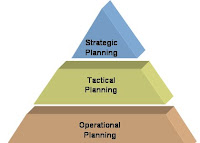
Strategic planning focuses on the future direction and position organisi. Two blgo first in three consecutive series focusing on strategic thinking and planning long term, that together to cover the strategic aspects of planning. tactical planning, which became focus of this book, discusses the implementation of strategic plans and production of short-term results. Regarding the overall planning process. note that each of the two first components of the process through to the next component, ultimately leading to an effective implementation plan.

My observation is difficult, if not impossible, to run strategic planning and tactical at the same time. When you discuss issues of strategic and tactical, tactical urgency of interest you will tend to dominate. strategic planning, on the one hand, more intuitive than analytical and more focused on the external environment and the factors which probably requires a fundamental change during the period of extension. Tactical planning, on the other hand, many analytical, more focused into, and much more specific and detailed.

Tactical planning plays a different role with planning strategic planning process of your organization. If the strategic planning bagimana should focus on your organization's business and the direction where to go, tactical planning focusing on the direction-term objectives Short of your organization and how to get there. plan tactical usually have a period of one year and generally prepared for ages last of the previous fiscal year. Your tactical plan to be developed after the strategic plan (which is usually prepared at the beginning of the year), because one of the goals of the tactical plan is to carry out part of the plan strategically.

The planning process can be started with a strategic plan or plans tactical, or a combination of both (eg preparing a mission statement prior first, and then initiate a plan to achieve short term results, depending on your needs. important to note that the planning process has a nonlinear nature and repetitive. You can start with any element in the process relating to your current needs this. Next, the completion of the element specific eremen may cause Your review the assumptions and decisions which are made therein, to ensure consistency and accuracy of projections. as well as those who need to act to make your organization more successful become more know about the various stages of planning and more actively involved in it, their commitment to significant results will become increasingly important. Remember, the purpose of planning is not primarily to produce a plan, but gets results. planning is the process of and the focus of this blog is to make it different at all levels.